
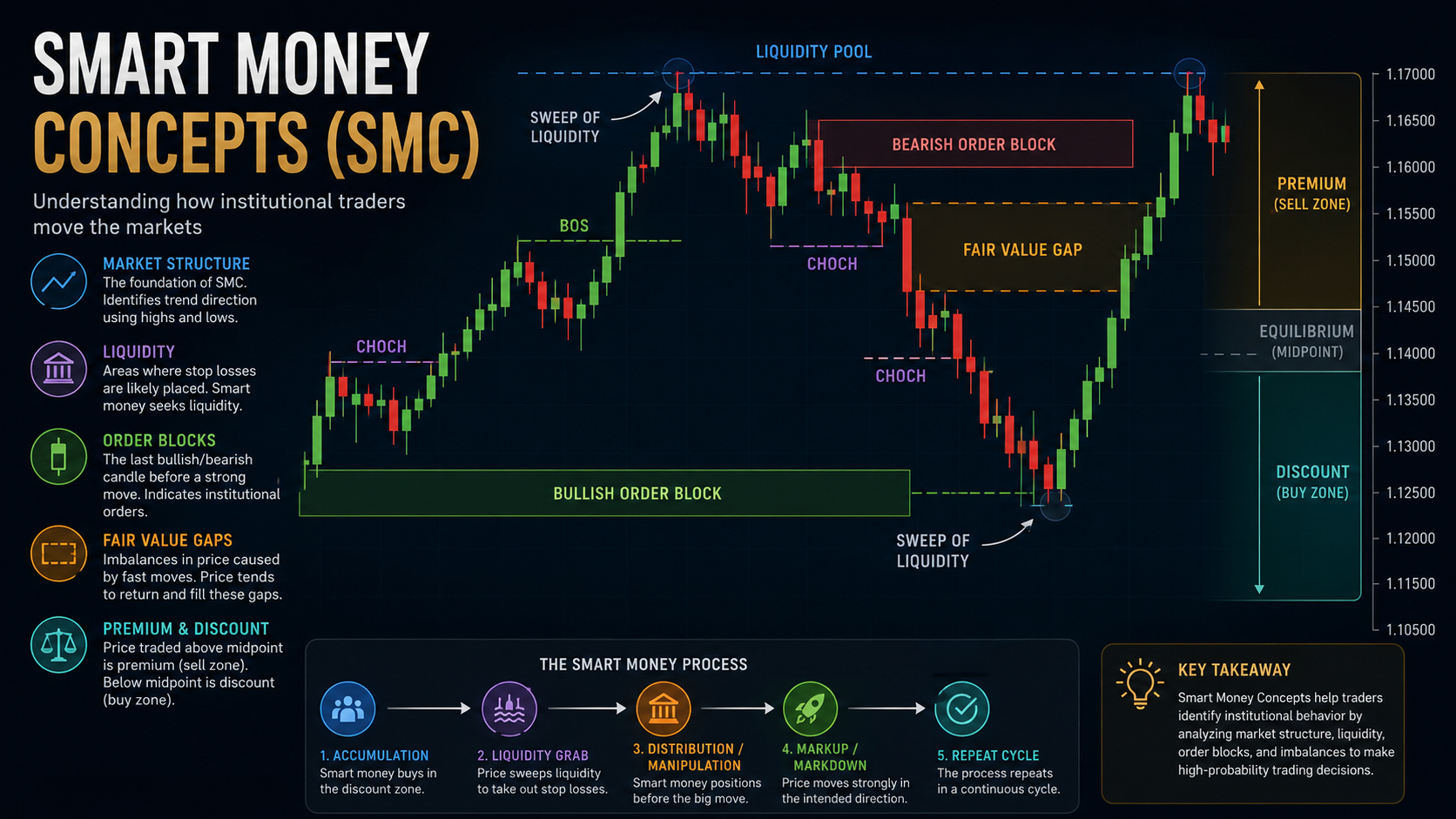
Smart Money Concepts (SMC): A Complete Guide to Institutional Trading Strategies
Smart Money Concepts (SMC) has become one of the most discussed trading methodologies among retail and professional traders alike. Unlike traditional technical analysis that focuses primarily on indicators, Smart Money Concepts attempts to identify how institutional investors, banks, hedge funds, and large financial organizations move the markets. By understanding where these major participants buy, sell, accumulate, and distribute positions, traders attempt to align themselves with institutional order flow instead of trading against it.
Whether you trade stocks, forex, commodities, cryptocurrencies, or futures, Smart Money Concepts provides a structured framework for analyzing price action. Rather than relying solely on lagging indicators, SMC emphasizes liquidity, market structure, supply and demand imbalances, and institutional behavior.
This comprehensive guide explores the foundations of Smart Money Concepts, explains its most important terminology, discusses how institutional traders influence financial markets, and provides practical methods for incorporating SMC into your trading strategy.
What Are Smart Money Concepts?
Smart Money Concepts is a price-action-based methodology that studies how institutional investors participate in financial markets. The theory assumes that major financial institutions possess significantly more capital, market information, research capabilities, and execution tools than retail traders.
Because institutions cannot instantly buy or sell enormous positions without affecting price, they often leave identifiable footprints on price charts. Smart Money Concepts attempts to recognize these footprints before large market moves occur.
Instead of asking whether an indicator gives a buy or sell signal, SMC asks questions such as:
- Where is liquidity concentrated?
- Where are retail traders likely placing stop losses?
- Where are institutions accumulating positions?
- Has market structure shifted?
- Is price filling an institutional imbalance?
The answers to these questions help traders understand the intentions of larger market participants.
Why Smart Money Matters
Institutional investors—including commercial banks, investment banks, pension funds, hedge funds, mutual funds, sovereign wealth funds, and large asset managers—control the overwhelming majority of global trading volume. Their transactions often determine long-term market direction.
Retail traders generally execute relatively small orders that have little influence on market prices. Institutions, however, must carefully manage their entries and exits because buying or selling billions of dollars at once would dramatically impact prices.
This creates recognizable patterns that Smart Money Concepts seeks to identify.
Core Principles of Smart Money Concepts
1. Market Structure
Market structure forms the foundation of Smart Money Concepts. Traders analyze the sequence of higher highs, higher lows, lower highs, and lower lows to determine whether a market is trending upward, downward, or consolidating.
An uptrend generally consists of:
- Higher highs
- Higher lows
- Bullish continuation
A downtrend generally consists of:
- Lower highs
- Lower lows
- Bearish continuation
Understanding market structure helps traders determine the prevailing institutional bias.
2. Break of Structure (BOS)
A Break of Structure occurs when price successfully breaks through a previous swing high or swing low, confirming continuation of the existing trend.
For example:
- Breaking above a previous high confirms bullish continuation.
- Breaking below a previous low confirms bearish continuation.
BOS helps traders avoid entering trades against institutional momentum.
3. Change of Character (CHOCH)
A Change of Character signals that institutional order flow may be shifting. Instead of confirming continuation, CHOCH often suggests that trend reversal is becoming increasingly likely.
For example, after a prolonged downtrend, price may suddenly break above the most recent lower high. This represents a possible transition from bearish to bullish market structure.
Many Smart Money traders wait for both a Change of Character and confirmation before entering reversal trades.
Liquidity: The Heart of Smart Money Concepts
Liquidity refers to areas where numerous buy or sell orders are concentrated. Institutions require liquidity because they need counterparties willing to take the opposite side of their enormous trades.
Common liquidity zones include:
- Previous highs
- Previous lows
- Equal highs
- Equal lows
- Trendline stops
- Round psychological price levels
Institutional traders often move prices toward these liquidity pools before reversing direction.
Liquidity Sweeps
A liquidity sweep occurs when price briefly moves beyond obvious support or resistance levels to trigger stop-loss orders before reversing.
Retail traders frequently interpret the breakout as confirmation, only to discover that price quickly reverses.
Smart Money traders view these sweeps as evidence that institutions have collected liquidity necessary to enter larger positions.
Order Blocks
Order blocks are among the most recognizable Smart Money Concepts.
An order block represents the final bullish candle before a significant bearish move or the final bearish candle before a major bullish move.
These zones often indicate areas where institutions accumulated or distributed large positions.
When price later revisits an order block, many traders monitor the area for potential entries because institutional interest may remain active.
Fair Value Gaps (FVG)
Fair Value Gaps represent price imbalances created when aggressive buying or selling causes rapid movement without sufficient opposing transactions.
These gaps often appear as three-candle formations where the middle candle creates a significant imbalance.
Many Smart Money traders believe price frequently returns to fill these inefficiencies before continuing its overall trend.
Premium and Discount Pricing
Smart Money Concepts often divide price ranges into premium and discount zones.
- Premium: Higher portion of the trading range where institutions may look to sell.
- Discount: Lower portion where institutions may seek buying opportunities.
Using Fibonacci retracement levels, many traders identify approximately the midpoint of a price range as equilibrium.
Buying within discount zones and selling within premium zones aligns with institutional logic rather than emotional retail behavior.
Mitigation Blocks
Mitigation blocks occur when institutions revisit previous trading areas to reduce exposure or complete unfinished transactions before continuing the trend.
These zones often become high-probability areas for continuation trades.
Supply and Demand
Although supply and demand analysis predates Smart Money Concepts, the two methodologies share several similarities.
Demand zones represent areas where buying pressure previously exceeded selling pressure.
Supply zones represent areas where selling pressure overwhelmed buyers.
Institutional traders often create these zones during accumulation and distribution phases.
Accumulation and Distribution
Accumulation occurs when institutions gradually purchase large positions without significantly increasing market prices.
Distribution occurs when institutions gradually sell positions before a decline.
Both phases often appear as prolonged consolidations before explosive moves.
How Smart Money Concepts Compare to Traditional Technical Analysis
| Traditional Analysis | Smart Money Concepts |
|---|---|
| Uses indicators | Focuses on raw price action |
| Emphasizes patterns | Emphasizes institutional behavior |
| Looks for breakouts | Looks for liquidity sweeps |
| Relies on moving averages | Relies on market structure |
| Focuses on momentum | Focuses on order flow |
Advantages of Smart Money Concepts
- Provides deeper understanding of market mechanics.
- Works across multiple financial markets.
- Can improve trade timing.
- Encourages disciplined risk management.
- Reduces dependence on lagging indicators.
- Aligns trading decisions with institutional activity.
Common Mistakes When Learning Smart Money Concepts
- Ignoring higher time-frame market structure.
- Trading every liquidity sweep.
- Failing to wait for confirmation.
- Using excessive leverage.
- Overcomplicating chart analysis.
- Neglecting proper risk management.
Risk Management Remains Essential
No trading methodology—including Smart Money Concepts—can eliminate risk. Financial markets remain unpredictable, and even high-probability setups can fail.
Professional traders generally focus on preserving capital through disciplined position sizing, predefined stop losses, and consistent risk-to-reward ratios.
Successful trading depends just as much on risk management as it does on identifying quality trade opportunities.
Can Beginners Learn Smart Money Concepts?
Yes. While Smart Money Concepts introduces terminology that may initially seem complex, beginners can gradually build proficiency by mastering market structure before progressing to liquidity, order blocks, and fair value gaps.
Rather than memorizing definitions, traders benefit most from studying historical charts and identifying institutional behavior across different market conditions.
Markets Where Smart Money Concepts Can Be Applied
- Stock market
- Forex market
- Cryptocurrency
- Futures
- Indices
- Commodities
Because institutional order flow influences virtually every liquid financial market, Smart Money Concepts can be adapted across numerous asset classes.
Continuous Education Matters
Financial markets evolve continuously. Traders who commit to ongoing education, disciplined practice, and sound risk management generally place themselves in a stronger position than those relying solely on indicators or social media trading signals.
Understanding institutional behavior represents only one component of becoming a consistently successful trader. Developing emotional discipline, maintaining detailed trading journals, and reviewing past performance remain equally important.
Investors and aspiring finance professionals interested in expanding their understanding of markets, investment strategies, and institutional decision-making can explore additional educational resources at Lampkin Luminary Capital Partners, where readers can find insights covering investing, financial markets, private equity, real estate, entrepreneurship, and long-term wealth creation.
Final Thoughts
Smart Money Concepts has transformed how many traders interpret price action by shifting the focus from technical indicators to institutional behavior. By studying market structure, liquidity, order blocks, fair value gaps, premium and discount pricing, and changes in market character, traders gain a more comprehensive framework for understanding why prices move.
While no strategy guarantees success, Smart Money Concepts encourages traders to think beyond traditional chart patterns and instead analyze the underlying mechanics of supply, demand, and institutional participation. Combined with disciplined risk management, patience, and continuous learning, this methodology can serve as a valuable addition to a trader’s analytical toolkit.
For more educational content covering investing, financial markets, business strategy, wealth building, and institutional finance, visit Lampkin Luminary Capital Partners and continue expanding your financial knowledge.
Leave a Reply